Showing posts with label bees. Show all posts

Wednesday, April 9, 2014

Springtime garden update

I love April in the garden. Everything is warming up and drying out from our typical March sogginess (especially bad this year, with our record rainfall). Everyone's been enjoying the sun breaks as of late, including Mini-kitty (who is now 14 years young... she's become a pro at lounging). 


The peas, seeded on President's Day weekend, are a good 6" tall and climbing. The brassicas, which were seeded just last weekend, have already popped as well.


The garlic is doing great and is well on its way to our finest ever harvest (fingers crossed).  I planted four varieties this year, all purchased from Uprising Seeds in Bellingham. All of this garlic is bred in the beautiful Methow Valley.


Friday, August 9, 2013

Oregano Buzz

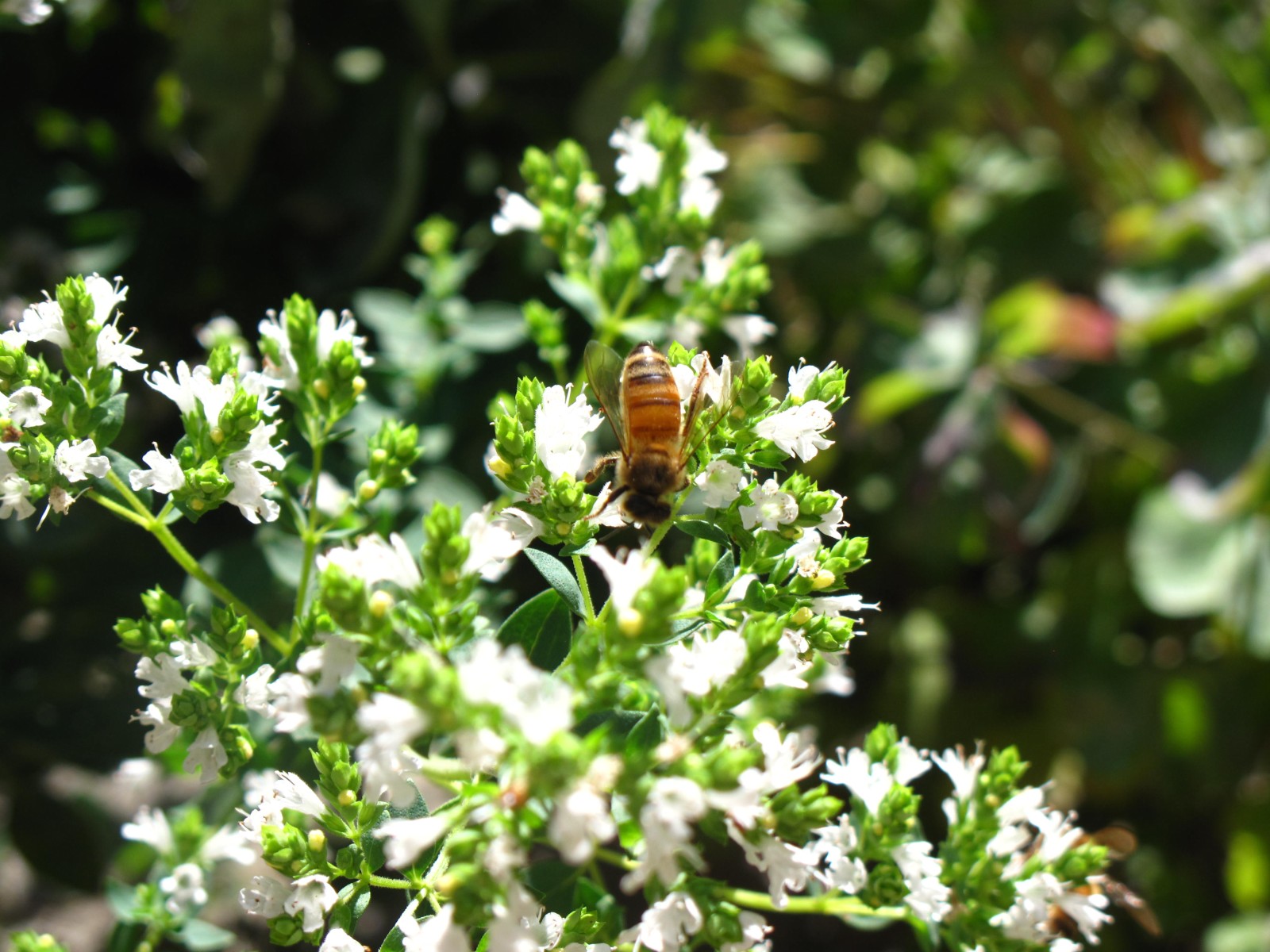
The oregano is blooming. A tidier gardener might have been tempted to trim it back, but I'm not tidy, plus I'm fascinated by this herb's frequent visitors of late.

The oregano patch starts each morning quietly, in the shade. When the sun comes out, the entire patch lights up with buzzing.  Bumblebees can't resist this delicate white bloom. 


Honeybees are equally drawn to these frilly cups, and it's fascinating to watch them forage.


I'm hoping some of that oregano flavor makes its way into the honey this year. 

Happy Friday from Chase!


Saturday, March 23, 2013

Sprouts and Seeds

I took advantage of a sun break between wind and rain squalls to spend some time in the garden today.  I seeded brassicas - cabbage, broccoli, kale, raddicchio and broccoli raab, and prepped another bed for carrots, turnips, spinach, lettuce and arugula, which I'll seed tomorrow morning.  

I did a little weeding along bed edges, but mostly just spent some time watching the garden wake from her winter nap. 

The red kale has overwintered nicely. Actually, it overwintered looking pretty wimpy, but just this week has burst out with large, tender, juicy leaves.  I'm always impressed by this plant's ability to thrive in our climate.


Wednesday, November 28, 2012

Honey Harvest


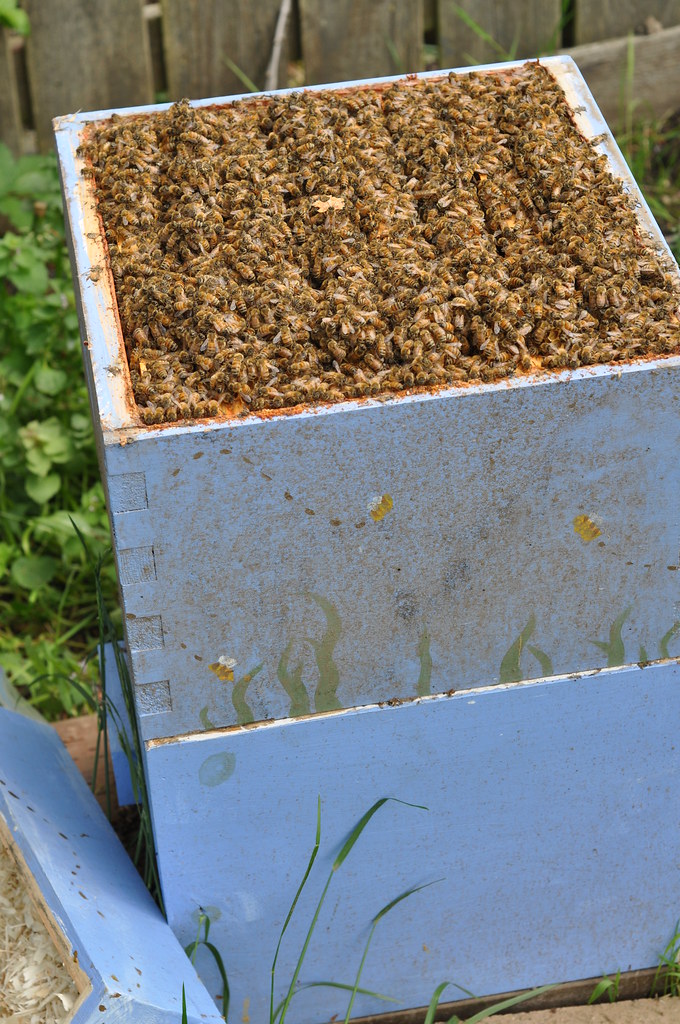
In September, we celebrated a huge milestone around here-- our first honey harvest.Our ladies did such a great job producing honey this year that we decided we could take some without harming their winter honey stores.

This was quite a learning process for us.  First, we had to figure out how to get the honey out of the hive.  According to google, a number of methods exist. There's the chemical approach, where one applies a bee repellant to the hive.  Blech.  Totally not appealing to me, as this defeats the purpose of natural/ organic beekeeping.  Alternately, we could buy an expensive bee blower and  blow the bees out.  This was also not appealing, for cost reasons and because it seems unpleasant for the bees.  Some people also just brush bees off each frame, but in general, I'm not a big fan of the bee brush because it aggravates my bees and I'm more likely to get stung.

The method we settled upon employs a device called a "bee escape," which is basically a bee maze in which bees can crawl down, out of the top box, but not back up.  This method works because bees navigate with a set of specific rules.  When they reach a wall or corner, they always travel to the right and follow the wall until they reach a corner.  They never turn left. So, as long as you build a maze with right-leading exits, the idea is that the bees won't leave.  I found some plans online then recruited my favorite carpenter to help me build the bee escape.

Wednesday, June 20, 2012

Happy Pollinator Week!

Bet you didn't know that this week is National Pollinator Week.  Initiated and managed by the Pollinator Partnership, National Pollinator Week is designed to raise awareness about the growing crisis of declining pollinator populations worldwide. The Pollinator Partnership does all kinds of other great things to support and promote healthy pollinator populations.  For example, they publish regional planting guides that offer plant lists of pollinator-attracting plants, as well as tips to create healthy pollinator habitat.  

I've planted a lot of flowers over the past year, and I've been amazed at the diversity of pollinators present in our yard.  Here are some of my favorite bumble bee pollinators:  


This one is a fuzzy, little yellow bumble bee which frequents raspberry plants. Maybe she is a Bombus mixtus?   (There are many bumble bee species, but she seems to resemble other Mixtus specimens).  

Wednesday, May 9, 2012

A Tale of Two Swarms

Last week I took advantage of a nice sunny evening to wander over to the bees and check up on them post split.  I saw this in one of the trees:

Apologies for the image quality.  My camera is being repaired!

Tuesday, May 1, 2012

Hive Split Attempt, Part II (with more of Venessa's amazing pics!)

To recap, Venessa and attempted a hive split two weeks ago, but had very little information to evaluate whether we did it correctly. In order to devise a strategy to get both of our hives queenright (having healthy, laying queens), we needed some more information.  We needed to make sure that the queenless hive had either open brood or a queen cell, and that both hives had plenty of honey to eat.

We waited for the sun to come out, which fortunately it did on Saturday.  The first inspection was on hive 1, which we suspected would be queenless. The bees had been riled up in the first week after the split, and the hive had emitted a distinct hum. Also, in the previous two weeks I had seen bees hanging out on the front of the hive, looking aimless and lazy.  All of these are signs of queenlessness.

However, when we opened the hive, we were surprised to find a very full, calm, purposeful, hive of bees who had drawn a lot of comb in the last two weeks.

That is a full hive, especially after a recent split! Photo by  Venessa G.  

Tuesday, April 17, 2012

Hive Split Attempt, Part I

My last bee post recapped the sad ending to my sweet bee hive.  Fortunately, my co-keeper Venessa's hive had an amazingly healthy winter, and by early April, was showing signs of an impending swarming (the natural reproductive means for honey bee colonies).  Rather than attempting to catch a swarm (which can be done, if you happen to be around when the hive swarms), we wanted to split this healthy colony into two smaller ones.  The ideal situation would be to time this split right when the hive is starting their normal swarm activity.

When bees are about to swarm, the hive builds 2-4 queen cells, and feeds the larve in these cells plentiful amounts of Royal Jelly, a highly nutritious substance that transforms normal worker bee larvae into Queen larvae.  While the new queens are incubating, the existing queen gathers a portion of the workers to leave the hive and seek out new space, splitting the colony into two. The remaining workers stay behind to support the colony and tend to the emerging queens, who, immediately upon hatching, have a battle to the death to determine the new ruling queen.  That queen bee which kills her competitors while evading their stingers is the victor.  (Very Hunger Games-esque, but with only females- Queen Katniss will have no Peeta to help defend her in the Hive Hunger Games. Honey Games? I digress).

Tuesday, March 27, 2012

Beefuddled

The most recent check in my hive revealed a sad, small cluster of bees milling about the top of the hive.  Numbers were way down, and there was evidence of dyssentry (bee-diahhrea).  I gave them a Beepro pollen patty and a feeding of Pro-Health as a final desperate attempt to keep them alive, but to no avail- the hive did not make it.

A few sad bee carcasses (One of Venessa's lovely shots from her blog, Kernels and Seeds. 

Friday, February 10, 2012

Seed Uprising

As a reward for planning my garden out ahead of time this year, I splurged on some unique varieties of flowers, fruits and veggies from Uprising Seeds.  Based in Bellingham, Uprising is an amazing business. They offer only organic and open- pollinated varieties while supporting a strong network of seed growers in the state. They do meticulous research on varietial performance, and they know their seeds extremely well!  They don't carry the variety that some of the larger seed companies do, but each seed description is extremely thoughtful and helpful, and all of their seeds are chosen with our Northwest maritime gardening climate in mind.

The bulk of our garden will grow from seeds on hand from last year- but, I still found an eclectic mix of beauties too add to our garden space. I chose exotic blooms (for the bees, and to feed my love of cutting flowers), some unique greens, and some heirloom veggies which I hope will become jewels of our harvest.

All photos from Uprising Organics online seed catalog.  

Monday, January 16, 2012

Mid-winter Bee Check Up (with beecam)

With the exception of today's snow, its been a relatively mild winter in Seattle, much to the benefit of our bee ladies. Venessa's hive has been doing great, staying clustered up and working slowly through their honey stores. In a recent peek hrough the window, they were clustered close to the glass, slowly vibrating, a collective calm enveloping them.

By contrast, my hive appears to have worked through their honey stores much more rapidly and has nearly run out. Recent peeks into the viewing window reveal a much more chaotic scene. 


Saturday, October 15, 2011

Breaking Ground at the Rainier Beach Urban Farm


Saturday, October 1 was the official ground breaking of the Rainier Beach Urban Farm. The other FACN board members and I have been really busy over the past 8 months getting this neighborhood farm project off the ground- writing grant applications, negotiating operating agreements with Seattle Parks, and also figuring out the details of our relationship with Seattle Tilth, our fiscal sponsor.  Although there have been work parties every Saturday for most of the summer and fall, this was really our first public event.  The concept was a mini-version of the Seattle Tilth Harvest Festival, but with more of a focus on this particular farm.  We envisioned farmers market style vendors, a plethora of community organizations, tours of the farm, live music, and plenty of kids activities. We had no idea how many people were going to show up, and whether the event would be a success, but we set attendance goals that we thought were reasonable, settled on a budget, then put our heads down and got to work.  

My job was to recruit organizations to table, bands to play music, and farmers to sell produce.  Other committee members handled a ton of other details, including speaker/ elected official recruitment, volunteer coordination, event promotion, poster/ graphic design, food/ flower procurement, event logistics and layout. A lot of these jobs were new to us, but we just kept plowing through to do lists and meetings, and pretty soon it was the week of the event.  Saturday morning greeted us with rain, which fueled my anxiety that no one would show up.  Like magic, however, over 40 volunteers materialized, and got to work setting up. By 10am people started trickling in, and for most of the day we had a good sized crowd there despite the weather.


Thursday, July 21, 2011

Averting a bee-mergency (stopping a swarm)

The other morning I was doing a routine check on the bees and I noticed that bees in Venessa's hive were clumped around the entrance, not being as active as usual, just kind of hanging out, in large numbers....  basically, showing the first signs of swarm behavior, so far as I could tell.

Yup, we're just bees, hanging out, waiting to see where the party is... (scary for the beekeep!).


Friday, June 10, 2011

Bee Update (with BeeCam!)

So, despite the fact that my last blog post was about the bee install, in real time, our busy bee ladies have now been in place for nearly four weeks.  In that short amount of time, each hive has built 8-9 lovely white combs.  


Bees are coming in and out, gathering nectar and pollen.  Here's a video of the take off/ landing strip at the front of the hive one evening a few days ago:


Inside the hive, worker bees have been tending to the comb.  Here's some footage from the hive window- there are lots of bees doing the "bee dance," which is their method of communicating distance and direction of nectar and pollen sources. You can see one bee on the lower left hand part of the screen doing her bee dance over and over again.


 Other worker bees are busy filling each cell with pollen, which will be consumed by bee larvae after they hatch.  I haven't been able to see the queen yet, but the fact that workers are bringing in pollen is generally taken as a sign that the queen is in there, laying eggs. Here's a video of a worker bee depositing some pollen into one of the cells (look for the bright orange pollen, in the middle, to figure out which bee it is):


Anyhow, as you can see, I'm enamored with these bees. I find their bee life so intricate and fascinating.

In closing, a bit of bee humor for you (courtesy of co-keepers Joe and Venessa, via Abstruse Goose):

but_otto_is_a_woman-s_name

Thursday, June 2, 2011

Getting ready for our honeybees

I decided this year to get bees for our garden.  I love the idea of keeping thousands of happy pollinators around, and I'm also excited about the possibility of having gallons of sweet, fresh, local honey at the end of the season.  

I spent months researching different beekeeping methods and finally decided on the Warre method.  The Warre Method is a natural approach to beekeeping, grounded in philosophy that the bees possess inherent wisdom when it comes to best bee survival practices.  The Warre hive imitates a tree trunk- so it is smaller than normal Langstroth boxes, and square in shape.  The hives start out with two boxes, with boxes being added to the bottom of the bee hive as the colony grows and needs more space.  (Langstroths typically "super" additional boxes over the top of the existing boxes).  The theory is that the bees will start building comb and laying brood in the top boxes, then will work their way down as the season progresses.  As the brood hatches, the empty cells will be cleaned and used to store honey.  Harvesting honey, then, is relatively easy- you just take the top few boxes, as most of the bees will have moved down the hive as the summer progresses.  

Anyhow, here's a photo essay on our bee preparations..... 


Thursday, May 26, 2011

On Pedals and Petals

Lately I've been spending a lot of time in the garden, which has led me to dream up all kinds of gardening-related topics to write about. Every spring I get overtaken by this huge urge to get out in the dirt, pull some weeds, plant some seeds, and celebrate growth in my backyard. My sense of urgency to get my hands dirty is driven by the first emergence of the sunshine, the long daylight hours and by a deep desire to get seeds planted so I can enjoy the fruits of my labor during the lazy days of summer. These past two years I've struggled with how to balance my love of gardening with my love of riding bikes... especially during the springtime, when both pursuits require a high level of commitment in terms of time and money. Anyhow, as I continue to struggle with balancing these pastimes, I'm planning to chronicle my adventures in both cycling and gardening here.

I've been thinking about the similarities between riding bikes and gardening ever since asked this question by my friend Muuqi, as a part of an interview he did awhile back for his blog, Life Cycles (great blog, check it out!). Basically, it comes down to two main themes-  observation and investment.   Both acts- riding bikes and gardening- give you an opportunity to have a more intimate interaction with your natural surroundings than say, sitting on the couch or driving in a car.  These interactions help you develop keen observation skills, which I think makes you a better citizen of the world, or at least a more interesting person.  On investment- there is immediate satisfaction, from weeding a plot of land or building a trellis, or from sweeping around a perfect corner on a mountain bike, or reaching the top of a tough climb. There are also longer term rewards.  In the garden, you pick ripe fruit,  cut fresh greens, you savor the literal fruits of your labors.  Similarly, on the bike, you harvest a sense of growing strength and speed after investing in repeated workouts on the bike. 
Fruits of last  year's labors- giant lettuces